
Risk/Reward Matrix
Find the right balance between playing it safe and taking smart bets
EXECUTIVE SUMMARY:The Risk/Reward Matrix helps leaders evaluate opportunities by comparing potential payoff with the level of risk. It categorizes projects into four types: Oysters (high risk, high reward), Pearls (low risk, high reward), White Elephants (high risk, low reward), and Bread and Butter (low risk, low reward). By scoring and plotting initiatives on these two dimensions, organizations can see where to invest, scale, or divest, creating a balanced portfolio that blends innovation, growth, and stability.In our recent articles on the 2x2 Matrix, BCG Matrix, and Eisenhower Matrix we explored how two simple variables can turn complexity into clarity. The Risk/Reward Matrix continues that series, but this time, the focus is on how to evaluate strategic opportunities.
This matrix is often used in innovation and investment decision-making, helping leaders determine which projects to fund, which to scale, and which to let go.
The origin of the quadrant names emerged in the 1980s and 1990s, though it is a bit unclear who originally developed and popularized them together in this framework. Many credit McKinsey & Company or the Mathesons in their book The Smart Organization.
What is the Risk/Reward Matrix?
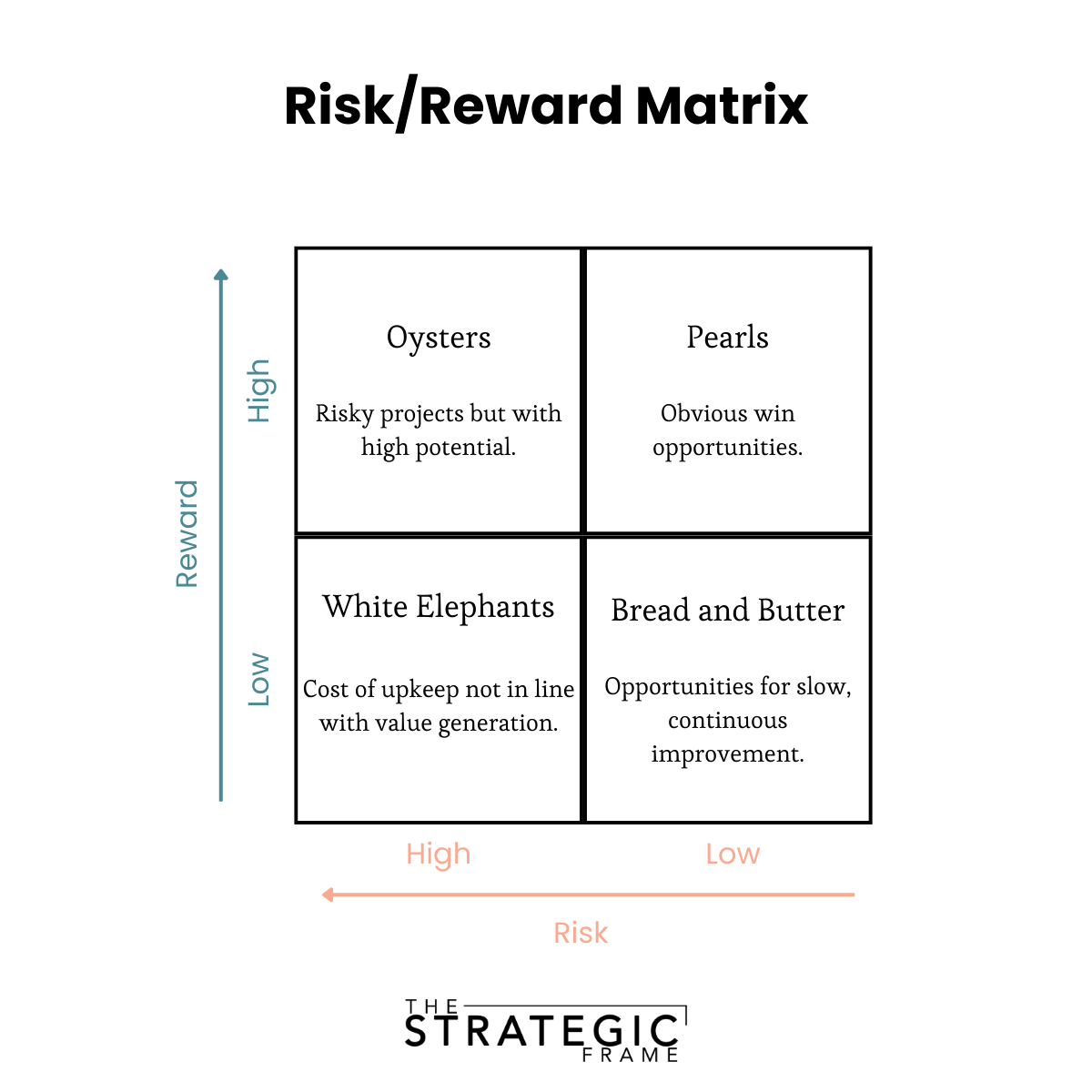
The Risk/Reward Matrix organizes opportunities based on their potential payoff and the level of uncertainty or exposure involved. It divides them into four distinct categories:
Oysters: High risk and high reward. These are bold, experimental bets with the potential for major breakthroughs. They often require creativity, patience, and tolerance for uncertainty.
Pearls: Low risk and high reward. These are proven opportunities or quick wins that reliably generate value. They are worth doubling down on.
White Elephants: High risk and low reward. These consume significant time and resources without producing commensurate value. They should be re-evaluated or phased out.
Bread and Butter: Low risk and low reward. These are steady, dependable activities that maintain consistency and ensure incremental progress.
When visualized, the matrix offers a look at how your current initiatives are distributed. A healthy innovation portfolio balances all four: nurturing Oysters, scaling Pearls, maintaining Bread and Butter, and cutting White Elephants.
What’s up with the Names?
The quadrant names in the Risk/Reward Matrix are metaphors that reflect the behaviors and decisions teams often face when managing innovation portfolios.
Oysters: Just like real oysters, these initiatives hide uncertainty inside. You cannot know whether an oyster contains a pearl until you open it. Oysters represent early-stage, high-risk projects where the goal is learning. They require curiosity, experimentation, and disciplined discovery. These initiatives are about uncovering hidden value, not chasing guaranteed payoffs.
Pearls: These are the success stories that emerge from your Oysters. They are proven concepts with strong market validation and manageable risk. Pearls represent high-value innovations that justify investment and scaling. They are precious because they combine desirability, feasibility, and profitability, a rare trio that makes them worth cultivating.
White Elephants: The term comes from ancient traditions where owning a white elephant was both an honor and a burden, beautiful but costly to maintain. In a business portfolio, these are projects that consume significant resources without delivering adequate return. They often persist because of emotional attachment or sunk-cost bias, even when they no longer serve the strategy. Similar to a bad gift at a White Elephant party during the holidays, these don't provide much value and might be a hassle to have in your possession.
Bread and Butter: These represent the core, reliable activities that sustain the business. Like daily bread, they are essential for survival but not transformative. Bread and Butter projects keep operations running smoothly, providing stability and steady revenue while supporting long-term exploration elsewhere in the portfolio.
How to Use the Risk/Reward Matrix
List all active and proposed initiatives: Include everything competing for investment, from new ventures to legacy programs.
Assess potential reward: Estimate the upside of each opportunity by scoring it from 1 to 10, with 10 representing the highest potential reward. Consider financial return, strategic value, or long-term growth impact.
Assess level of risk: Evaluate uncertainty, technical difficulty, market volatility, or resource requirements. Score each from 1 to 10, with 10 representing the highest level of risk.
Plot each initiative: Use your scores to plot each project on the matrix according to its risk and reward. When possible, base placements on data or agreed criteria rather than intuition so the visualization reflects objective insights.
Identify natural breakpoints: Define what counts as high or low for both axes. These thresholds may differ depending on your organization’s goals, industry, or risk tolerance.
Develop a plan by quadrant:
Oysters: Fund selectively and design learning milestones to uncover value.
Pearls: Scale efficiently and reinvest returns into future innovation.
White Elephants: Phase out or pivot toward better-aligned opportunities.
Bread and Butter: Maintain reliability while freeing capacity for exploration.
The goal is not to avoid risk entirely but to take the right risks that have a clear path to measurable learning or long-term gain.
Wrapping It All Up
The Risk/Reward Matrix turns uncertainty into structured decision-making. It gives teams a shared language for evaluating ideas and helps leaders balance bold innovation with disciplined focus.
If you mapped your current initiatives today, how many Oysters are you nurturing, and how many White Elephants are still on your books? What would it take to turn more of them into Pearls?
This email is sponsored by David White Marketing Services
David White Marketing Services exists to get you more leads, more online traffic, more sales and more phone calls. Schedule a discovery call at https://www.white.am/.
