
Eisenhower Matrix
Urgent or important? Take control of your time and priorities
EXECUTIVE SUMMARY:The Eisenhower Matrix is a time management framework that helps you prioritize tasks by evaluating two dimensions: urgency and importance. It divides your work into four categories: Do (urgent and important), Schedule (important but not urgent), Delegate (urgent but less important), and Delete (neither urgent nor important). By listing tasks, scoring them for urgency and importance, plotting them into these quadrants, and building an action plan, you can reduce reactivity, focus on high-value work, and make more intentional use of your time.In our recent article on the 2x2 Matrix, we explored how plotting two variables can uncover meaningful insights. We later applied that thinking to business portfolios in the BCG Matrix. Today, we’re shifting from company strategy to personal strategy with one of the simplest and most useful 2x2 frameworks: the Eisenhower Matrix.
Named after Dwight D. Eisenhower, the 34th President of the United States, the matrix is based on his famous principle:
“What is important is seldom urgent, and what is urgent is seldom important.”
Eisenhower used this mindset to manage competing demands as a five-star general and later as president. The framework that bears his name remains one of the most effective ways to prioritize when everything feels like it matters.
What is the Eisenhower Matrix?
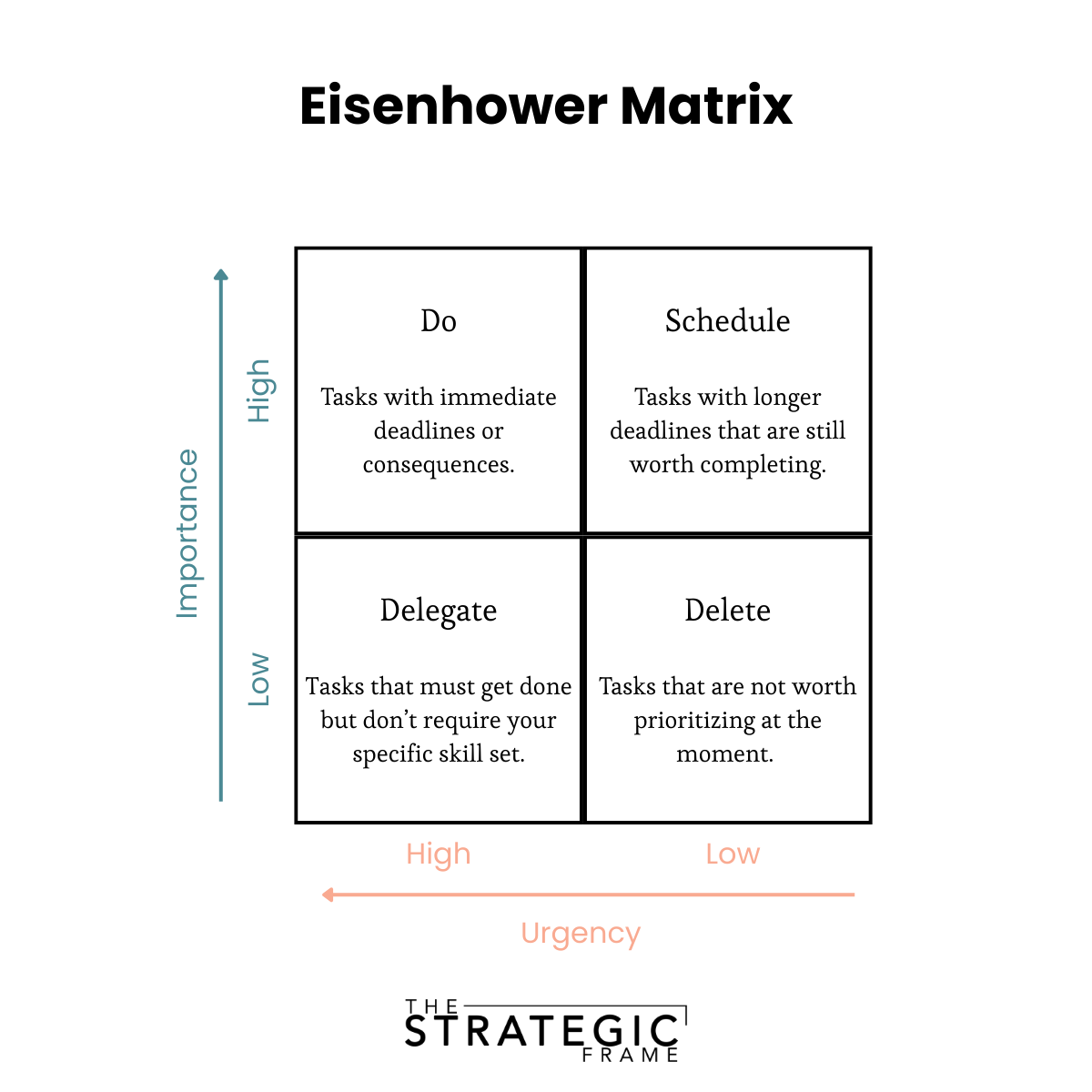
The Eisenhower Matrix organizes your to-do list into four quadrants based on urgency (how soon something needs to be done) and importance (how much it contributes to your goals).
Do: These are tasks that are both urgent and important. They often carry immediate deadlines or high stakes and should be handled right away. However, spending too much time here can create constant pressure, so the goal is to minimize surprises.
Schedule: These are important but not urgent. They include planning, learning, and relationship-building, the activities that create long-term value but rarely feel pressing. This is where strategy and growth happen.
Delegate: These are urgent but less important. They need to be completed but not necessarily by you. Delegating these tasks frees up your focus for higher-value work.
Delete: These are neither urgent nor important. They might feel satisfying to complete but contribute little to your goals. Eliminating or postponing them clears space for what truly matters.
This framework transforms your to-do list into a visual guide that reveals where your time and attention should go.
Steps to Use the Eisenhower Matrix
List all your tasks. Capture everything currently on your mind, from meetings to errands to long-term goals.
Evaluate importance. Ask yourself, “Does this help me achieve my main objectives?” Give it a score from 1 to 10 (10 being the most important)
Evaluate urgency. Identify what has immediate deadlines or consequences if delayed. Give it a score from 1 to 10 (10 being the most important)
Plot your tasks. Place each task based on the scores and label the quadrants: Do, Schedule, Delegate, or Delete.
Create an action plan by quadrant.
Do: Complete these first.
Schedule: Block time to focus on them when your energy is highest.
Delegate: Assign to someone else or automate.
Delete: Remove from your list entirely.
Review and rebalance regularly. Over time, aim to reduce your “Do” tasks and increase “Schedule” tasks, which are the ones that create long-term success.
Wrapping It All Up
The Eisenhower Matrix turns chaos into clarity. It helps you focus on meaningful progress instead of endless activity. Once you see your priorities divided across these four boxes, it becomes easier to protect your time, reduce stress, and work intentionally.
Which quadrant gets most of your time right now: urgent tasks or important ones? What would it look like to shift that balance this week?
This email is sponsored by Warrior Rising
Warrior Rising empowers U.S. military veterans and their immediate family members by providing them opportunities to create sustainable businesses, perpetuate the hiring of fellow American veterans, and earn their future. Learn more at https://www.warriorrising.org/.
