
The Value-Price-Cost Model
How does perceived value affect a product’s price?
EXECUTIVE SUMMARY:The Value-Price-Cost Model explains the relationship between what a product costs to make, what you charge for it, and what the customer believes it is worth. For a purchase to happen, perceived value must exceed price, and profit is the gap between price and cost of goods sold. Perceived value is made up of three parts: the product's tangible utility, the intangible brand, and the intangible marketing. Because branding and marketing raise perceived value without changing the product itself, they can both convert customers who would not have bought and support higher prices without hurting satisfaction.Two products can be functionally identical and still sell at wildly different prices. The gap in price point is explained by more than just markup. It comes down to what customers believe a product is worth before they ever see the price tag. Understanding how that perception gets built, and how much of it you actually control, is one of the most useful things a business owner can learn.
Consistency Is Key
Good storytelling must be consistent across every customer touchpoint. Whether someone sees your social media post, reads your website’s About page, or speaks with your customer service team, they should feel they are experiencing the same narrative. Consistency builds familiarity, familiarity builds trust, and trust is the foundation of long-term brand loyalty.
In the context of keeping people interested, storytelling is the bridge between understanding a customer’s lived experience and showing how your brand fits naturally into it. This turns a basic transaction into an ongoing relationship and allows a product to become part of someone’s identity.
When storytelling is done well, customers are not only more likely to buy from you, but they are also more likely to share your story with others. They become advocates who extend your brand’s reach far beyond what you could accomplish on your own.
Storytelling creates the emotional connection that draws people in, but a strong brand must also deliver on the practical side of the equation.
The Value-Price-Cost Model
To truly sustain growth, you must align your story with the tangible and intangible values you provide. This is where the Value-Price-Cost (VPC) Model comes in.
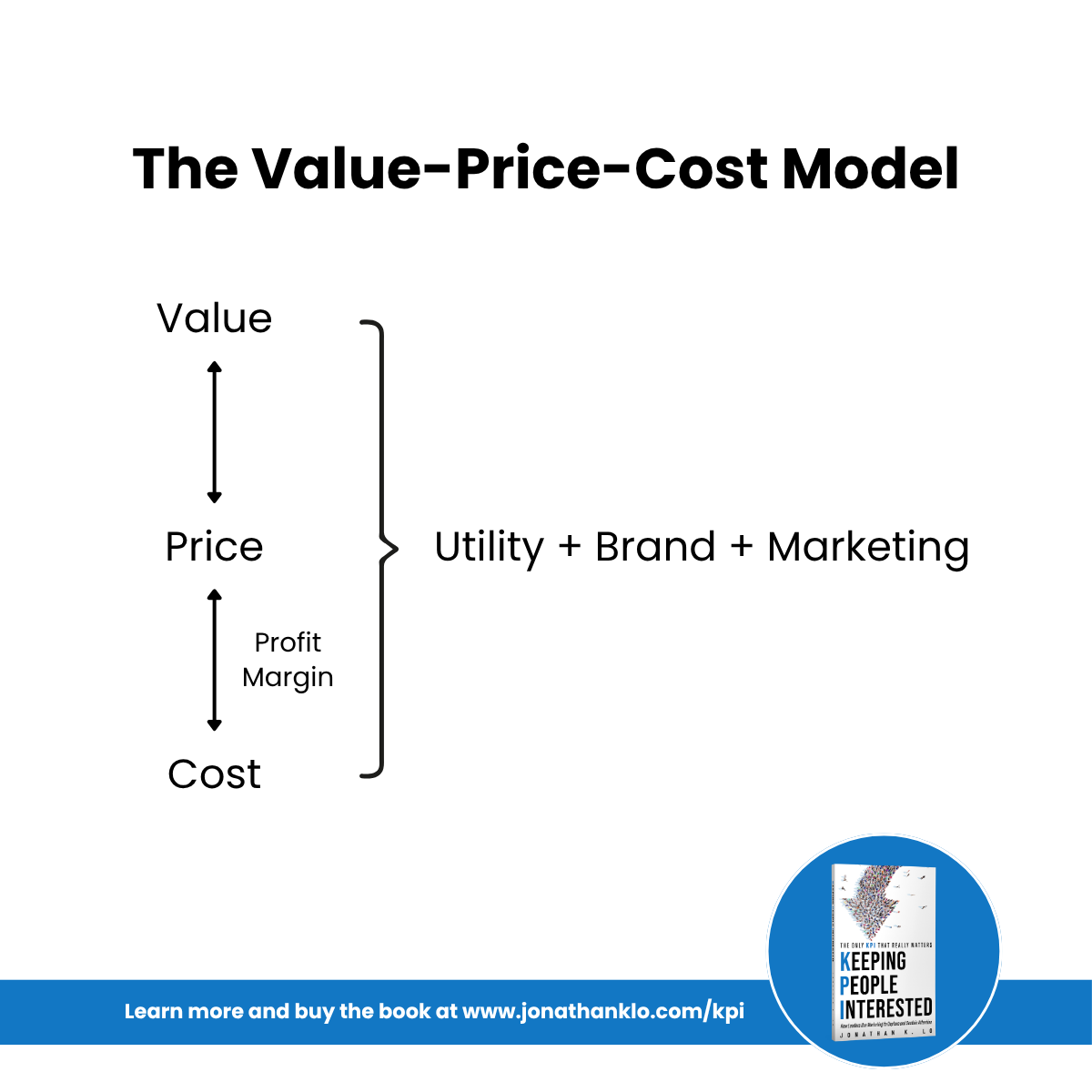
Think of the VPC Model as a ladder with moveable rungs. At the bottom sits your cost of goods sold. In the middle is the price you charge. At the top is the customer’s perceived value. For a purchase to happen, the perceived value must be higher than the price. Otherwise, customers will not buy. Your profit margin, how much you make per sale, is the difference between the price and your cost of goods sold.
But what exactly makes up value, and how can you increase it?
You can think of a product’s value to a customer as the sum of three parts:
The product’s tangible utility (what it does for the customer)
The intangible brand (how the customer feels about buying from you)
The intangible marketing (how you frame and communicate the product)
An Example of Perceived Value: Nike
Imagine you are preparing for a marathon. You need a pair of running shoes and may be willing to pay fifty dollars for the basic utility of a reliable shoe. That price reflects the functional value: the ability to run miles comfortably.
This should, in theory, be the maximum you are willing to pay. But now imagine the shoe is made by iconic shoe brand Nike. Even if the design is identical to a no-name brand, you prefer Nike. You trust the quality control, expect reliable customer service if anything goes wrong, and feel a sense of empowerment when wearing the brand. That emotional connection represents brand value. In this case, let’s say it adds another twenty-five dollars in perceived value.
Finally, Nike markets the shoe as one for marathons. They provide five clear reasons why this model is perfect for long-distance running. This positioning gives you confidence, inspiration, and the sense that you are making the right choice. That adds another twenty-five dollars in perceived value.
Now, although the shoe’s functional utility was worth only fifty dollars, the utility, brand, and marketing bring the customer’s total perceived value to one hundred dollars.
Thus, if the shoe costs Nike forty dollars to produce, they should charge one hundred dollars, right?
Not always. Not all customers perceive value the same way. Some may value the shoe at ninety dollars, others at eighty-one dollars.
If Nike prices the shoe conservatively at eighty dollars, both sides win. The company earns forty dollars in profit, and you feel you are getting twenty dollars more in value than what you paid. Following this model creates goodwill and repeat business.
Tips to Increase Perceived Value
Here’s the key insight: Branding and marketing increase your product’s perceived value without changing the product itself. This has two effects. First, it can convert people who previously would not have purchased. Second, it allows you to increase your prices while maintaining or even improving customer satisfaction.
So, how do you raise the top of the ladder and increase customer-perceived value? Here are some proven tactics:
Signal identity and confidence through consistency: A polished, consistent brand identity builds confidence. Apple does this through minimalist design, sleek packaging, and a seamless product ecosystem. Walmart does it through predictable pricing, straightforward merchandising, and a reliable message of everyday value.
Build emotional resonance: Align with a lifestyle, stand for values, or evoke aspiration and belonging.
Establish trust and reduce risk: Use familiarity (such as with brand impressions) and risk-free guarantees (such as with return windows and warranties) to show you stand behind your product.
Differentiate beyond features: A brand personality creates feelings that go deeper than functionality. Liquid Death, for example, sells water but creates a rebellious identity.
Create status for luxury: Prestige brands like Rolex, Hermès, and Lexus succeed by offering exclusivity, scarcity, and status.
Reinforce value at every touchpoint: From website design to packaging and from onboarding emails to customer support, every interaction should add to the customer’s perception of value.
The moral of the story: Invest in your brand, invest in your marketing, and everyone wins.
Wrapping It All Up
The Value-Price-Cost Model makes the value of brand and marketing concrete. They directly raise what customers believe your product is worth, which means they widen the space between your cost and your price. When you price below the perceived value you have built, both sides come out ahead, and that goodwill is what drives repeat business.
As you look at your own pricing, do you know what your customers actually believe your product is worth? What could you do to raise that number without changing the product at all?
Interested in more?
This article’s content was adapted from the book Keeping People Interested: How Leaders Use Marketing to Capture and Sustain Attention, available as a paperback, ebook, and audiobook today.
