
The Four Types of Content Your Brand Needs
Build awareness, shape perception, cultivate trust, drive action
EXECUTIVE SUMMARY:Content is any message a company creates to reach, inform, or influence an audience, and content marketing is the deliberate practice of using those messages to build interest over time. The most effective content balances what the customer needs with what the company needs, and falls into four types: entertain, educate, inspire, and convince. Entertaining content captures attention, educational content builds trust, inspirational content creates aspiration, and convincing content removes the friction that stands between interest and purchase. Auditing your existing content against these four categories reveals where you are strong and where there are gaps.When you post a piece of content, do you know exactly what job it is doing? Most brands produce content without a clear sense of what each piece is supposed to accomplish. They post because they are supposed to post. But content marketing works best when each piece of content has a clear purpose. Some of it exists to get noticed, some to build credibility, some to stir aspiration, and some to close the deal.
From Value to Visibility: Four Content Types
Increasing perceived value is only part of the equation. People cannot appreciate your value if they don’t know you exist. This is why brand awareness is essential. Awareness does not simply come from shouting louder. It comes from creating content that meets people where they are and gives them a reason to care.
Content refers to any message a company creates to reach, inform, or influence an audience. It includes short videos, articles, social posts, guides, podcasts, and emails. Content marketing is the intentional practice of using these messages to attract and nurture interest over time.
As American digital marketer, entrepreneur, and New York Times bestselling author Neil Patel explains, “When it comes to building brand awareness for my company, the method that’s worked best has been content marketing. Although it involves a lot of work, and it takes six months to a year for it to be effective, it’s been proven to provide the biggest bang for the buck.” His point underscores that meaningful awareness is not a quick win, but a deliberate investment in content that steadily builds trust and recognition over time.
The most effective content strikes a balance between customer needs and company needs, guiding people along the path from Awareness to Purchase. Four types of content do this:
Entertain
Educate
Inspire
Convince
Each type plays a distinct role in shaping perception and driving action, addressing customers’ rational and emotional needs while also serving the company’s goals of building awareness and driving purchases.
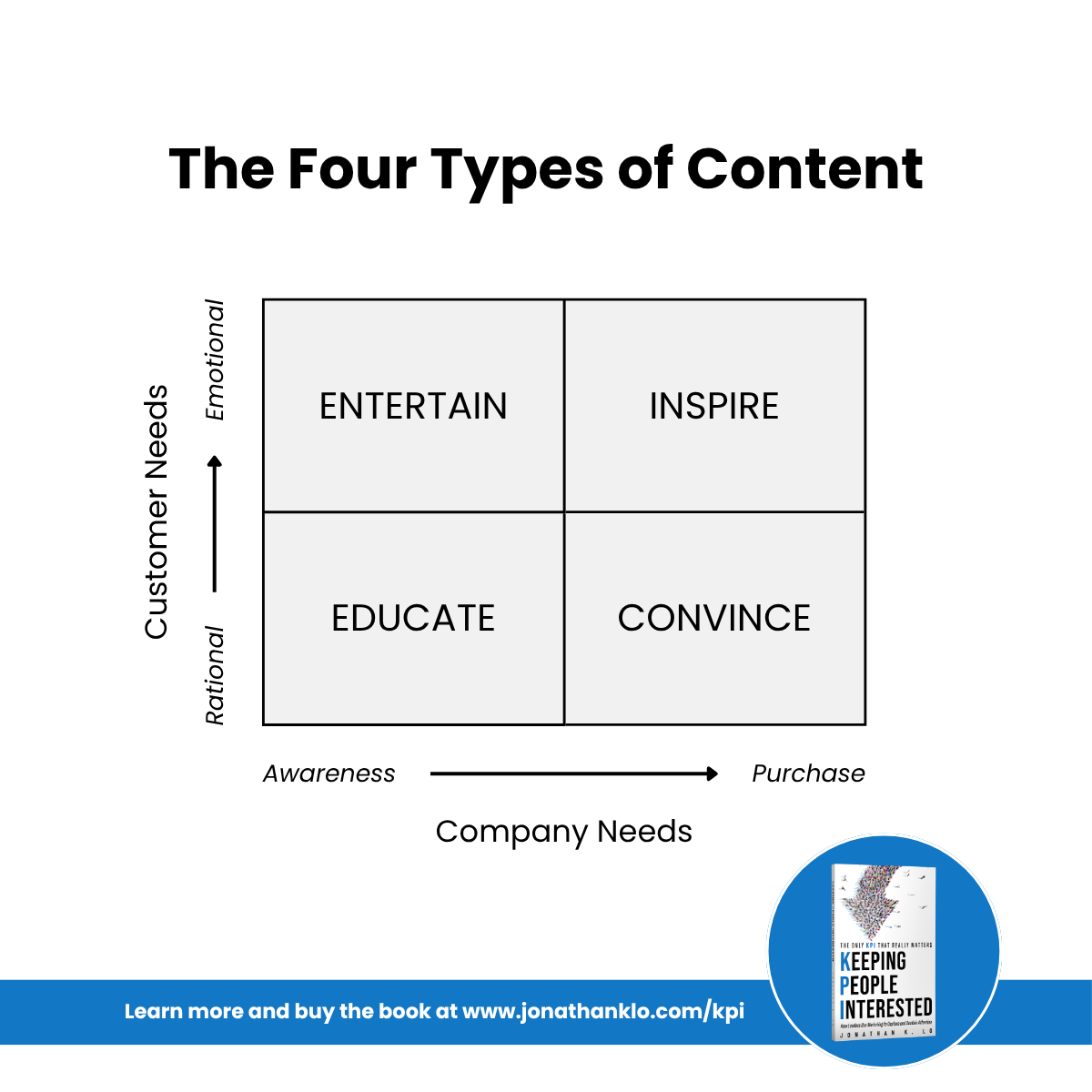
Entertaining content grabs attention. It meets the customer’s emotional needs and the company’s awareness needs. It sparks curiosity, humor, or joy, making people stop scrolling and take notice. Entertainment builds the emotional bridge that invites someone into your world for the first time.
Educational content provides clarity and builds trust. It meets the customer’s rational needs and the company’s awareness needs. By answering questions, solving problems, or breaking down complex ideas, it positions your brand as a reliable guide. This is often where awareness deepens into credibility.
Inspirational content taps into aspiration. It meets the customer’s emotional needs and the company’s purchase needs. It makes people imagine a better version of themselves, their work, or their life, with your brand playing a part in that transformation. Inspiration motivates someone to dream bigger and believe that change is possible.
Finally, convincing content closes the gap between interest and purchase. It meets the customer’s rational needs and the company’s purchase needs. It gives people rational reasons to act now: proof points, comparisons, testimonials, or guarantees that reduce friction and make the decision safe.
When these four types of content work together, they act as the front door to your brand. They draw people in, give them a reason to stay, and shape their perception of your value, regardless of whether they are ready to buy.
Structure Your Brand’s Content
One of the best ways to use this framework of the four types of content is as a brainstorming tool. Start by auditing your current content and mapping it into the four categories: entertain, educate, inspire, and convince. Look at everything you are creating, from blog posts and videos to social media updates and email campaigns. Ask yourself, “Which type does each piece of content serve?” This exercise will quickly show you where you are strong and where you might be underinvesting.
From there, consider the channels you use and how each type of content fits best:
Entertaining content often thrives on social platforms, such as TikTok, Facebook, or Instagram, where grabbing attention is critical.
Educational content may be more effectively delivered by blog articles, webinars, or YouTube, where people have the time and interest to go deeper.
Inspirational content is often well-suited to brand campaigns, founder stories, or longer-form video, where emotion and aspiration can shine.
Convincing content, on the other hand, is critical at the bottom of the funnel and belongs in emails, case studies, or product pages, where people make purchase decisions.
Thinking about channels this way helps you align not just the type of content you create, but also where you place it.
This process will also highlight gaps. Do you have plenty of educational resources but very little entertaining content to draw new people in? Do you inspire customers with a strong brand vision but fall short when it comes to providing convincing proof that your product is the right choice? By identifying these gaps, you can adjust your content mix so your customers experience a more complete journey.
Finally, align this framework with your brand identity and strategic priorities. Some companies may choose to over-index on inspiration because their product is aspirational by nature, while others may lean heavily on education if their offering is complex and requires explanation. Still others may need to double down on convincing content if they are in a highly competitive space. The point is not to treat the four types equally, but to use them intentionally to reinforce your brand and empathetically keep your customers interested in what you have to say.
Wrapping it All Up
Each content piece serves a distinct purpose: to entertain, educate, inspire, or convince. The right mix depends on your brand, your product, and how much explanation your offering requires.
Take a look at what you have published recently. Which of the four types are you leaning on the most, and which one could you focus more on? Does your current content mix support your company’s goals?
Interested in more?
This article’s content was adapted from the book Keeping People Interested: How Leaders Use Marketing to Capture and Sustain Attention, available as a paperback, ebook, and audiobook today.
Sources & Further Reading:
Melanie Bell, “50+ Quotes About Brand,” Strategic Piece, strategicpiece.com, May 2, 2025
