
The Marketing Funnel Demystified
Do you know where your customers are in the buying journey?
EXECUTIVE SUMMARY:The marketing funnel maps the six stages every customer travels through, from Unawareness to Advocacy, giving marketers and business owners a shared language for diagnosing where attention is growing or fading. Critics call it too simple, but a model doesn't need to capture every nuance to be useful. It needs to help you see more clearly, and this one does.Have you ever wondered why some customers never seem to move from curious to committed? Most businesses invest in marketing without a clear picture of what their customers are actually going through. They run ads, send emails, post content, and still can't pinpoint where interest stalls or why people drop off. The marketing funnel gives you that picture. It maps the full journey from the moment someone has never heard of you to the moment they're actively recommending you to others. And the reason it has stayed relevant for so long is not because it's perfect. It's because it works.
The Marketing Funnel
Marketing can be defined as the process of moving a target audience through the shopping journey. The natural next step is to understand what that journey looks like.
There are six stages in the shopping journey. They are:
Unawareness
Awareness
Consideration
Purchase
Repeat
Advocate
Together, these stages form what is commonly known as the marketing funnel. It earns this name because of the shape created when you visualize the number of people in each stage. The largest group sits at Unawareness, and the smallest group sits at Advocate.
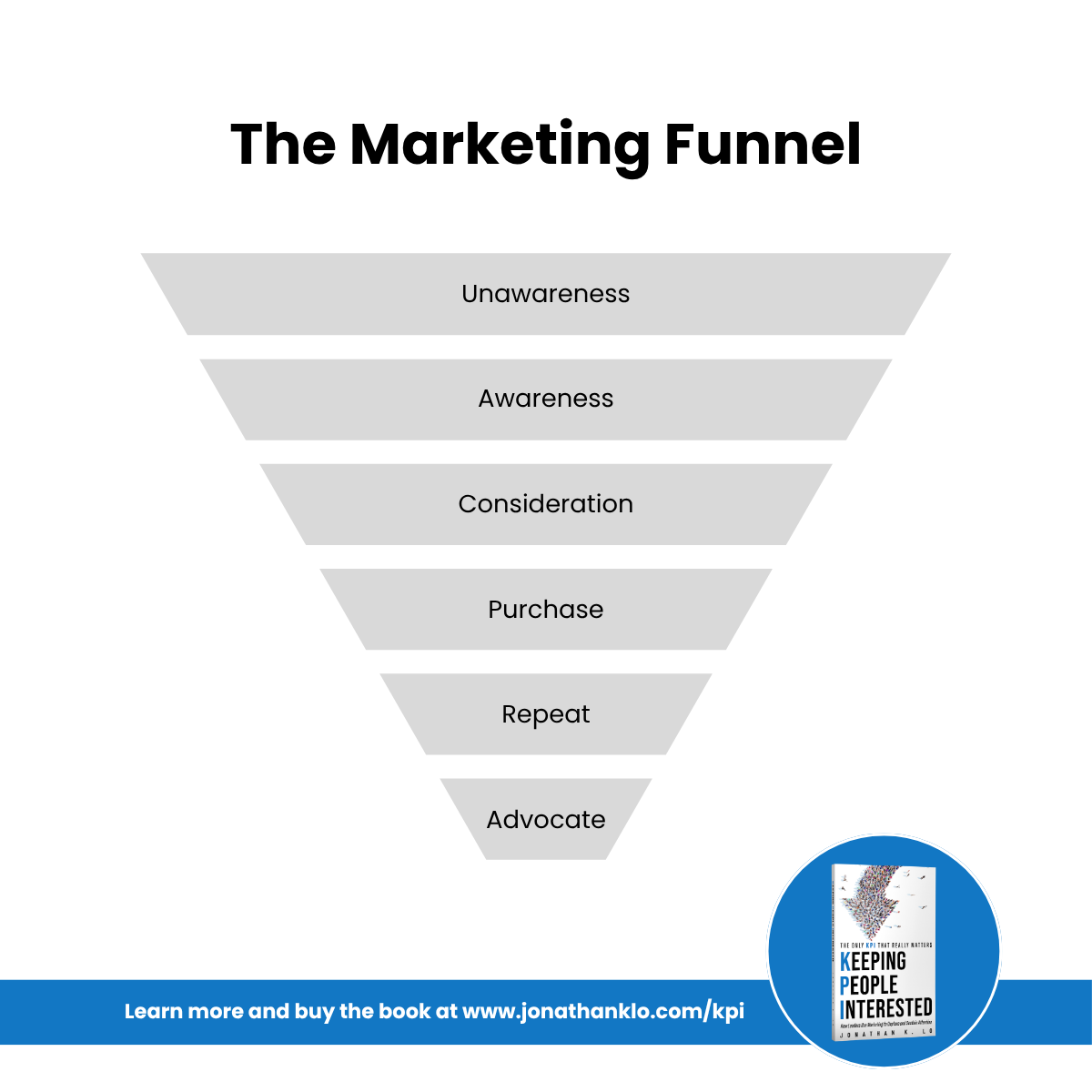
Here is a simple overview of the six stages:
Unawareness: The customer does not yet know your brand, product, or even that they have a problem you can solve.
Awareness: The customer becomes conscious of a problem and discovers your brand as a potential solution.
Consideration: The customer evaluates different options and gathers information to make an informed decision.
Purchase: The customer makes the decision to buy and completes the transaction.
Repeat: The customer returns for additional purchases, deepening their relationship with the brand.
Advocate: The customer actively promotes the brand to others through word of mouth, reviews, or content.
Many marketers criticize the funnel for being too linear and too simple. Human behavior is complex, so the concern makes sense. But a model does not need to reflect every nuance of reality to be useful. It only needs to help us see the world more clearly.
I learned this when I launched my consulting business. After fifteen years in the field, I resisted the funnel and tried introducing more complex alternatives. They looked impressive, but clients found them confusing and hard to use. They didn’t help anyone make better decisions.
But the funnel did.
It gave everyone a shared language. It made it easier to diagnose where interest was growing or fading. And it worked across industries and business models.
The marketing funnel may not capture every twist of the modern shopping journey, but it remains one of the most practical tools we have for understanding how customers move from curiosity to loyalty.
Wrapping It All Up
The marketing funnel has been around for over a century, and it has endured not because it's flawless, but because it gives teams a common language for talking about customers. When everyone can agree on where a prospect is in the journey, it becomes much easier to decide what they need next. As you think about your own marketing, do you know which stage is your biggest bottleneck?
Interested in more?
This article’s content was adapted from the book Keeping People Interested: How Leaders Use Marketing to Capture and Sustain Attention, available as a paperback, ebook, and audiobook today.
