
How Marketing Can Inspire, Motivate, or Prey
Can advertising make your life better?
EXECUTIVE SUMMARY:Have you ever encountered a brand that made you feel like a better version of yourself, not just sold you something? Marketing exists on a spectrum. Bad marketing preys on psychological triggers, good marketing motivates by connecting real solutions to real needs, and great marketing inspires by making customers feel capable of becoming a better version of themselves. Not all marketing is created equal, and most of us have felt the difference firsthand. Some brands make us feel like a better version of ourselves. Others introduce us to a product that solves a problem we already had. And others push us toward a decision we almost immediately regret. Marketing falls on a spectrum: great marketing inspires, good marketing motivates, and bad marketing preys.
Great Marketing Inspires
I believe marketing is good for the world and that advertising makes my life better, though I’m sure this is not a popular opinion. As customers, we have been frustrated by the flood of ads interrupting our lives. As companies, we have been frustrated that marketing isn’t doing its job helping the bottom line.
Okay, so maybe I need to revise my statement above. Marketing can be good for the world, and advertising can make lives better. But let’s face it. Not all marketing is equal. Over my years studying brands, both as a consumer and as a practitioner, I’ve observed that bad marketing manipulates, good marketing motivates, and great marketing inspires.
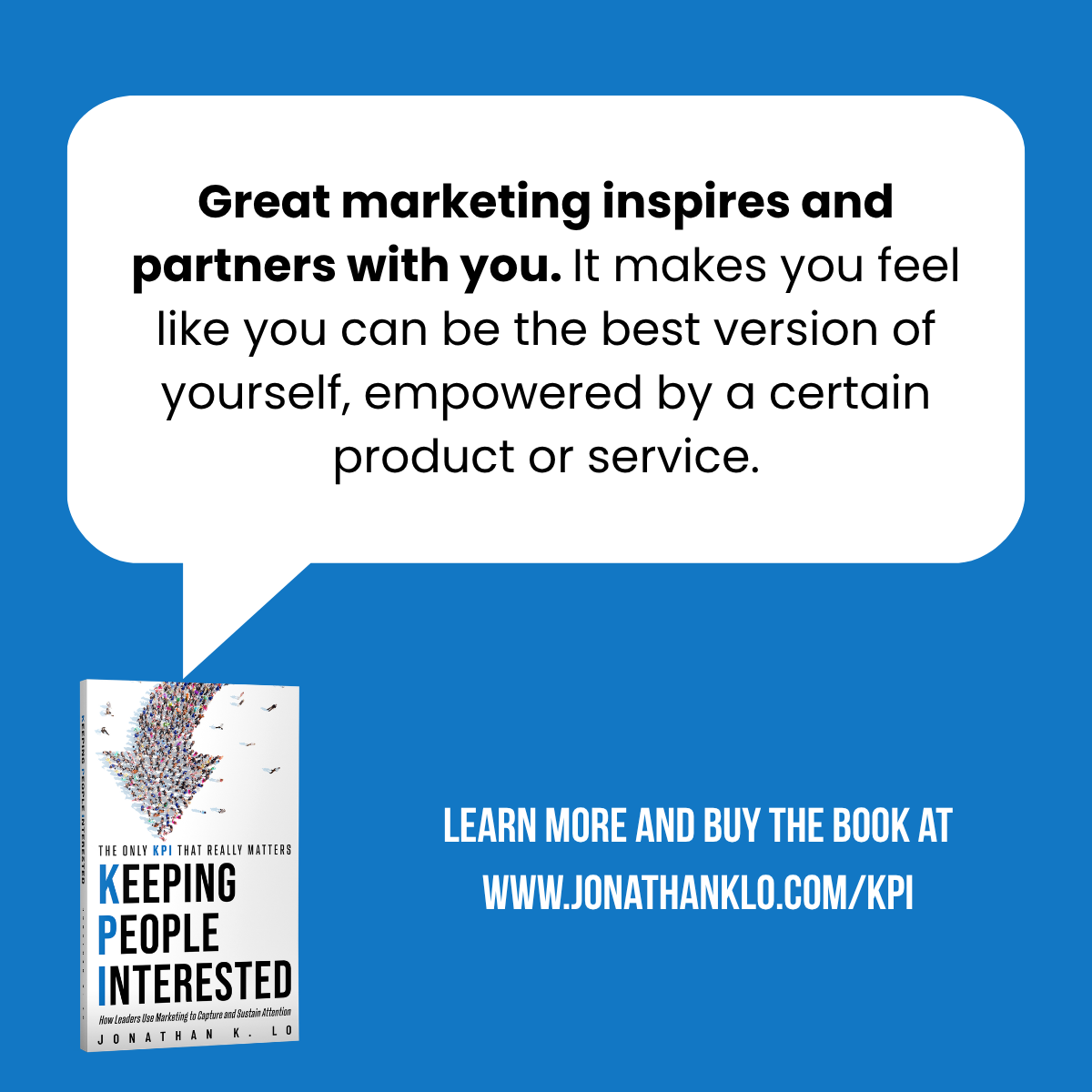
Great marketing inspires and partners with you. It makes you feel like you can be the best version of yourself, empowered by a certain product or service. And most importantly, it pays off this promise. You gladly pay the price because the value you receive is higher than the dollar amount you pay. We know great marketing when we see it. It’s refreshing. It’s not pushy. It’s fun and creative, and it makes us feel something and want to do something.
An example of this is Nike’s “Just Do It” campaign, launched in 1988. The focus isn’t on purchasing athletic shoes, but on inspiring people to be their best and conquer the odds. Nike reframed shoes as a symbol of human potential, which applied to both elite athletes and casual joggers. By 1998, in just ten years after its launch, Nike’s North American sports shoe market share grew from 18% to 43%, with worldwide sales increasing from $877 million to $9.2 billion.
Another example is personal care brand Dove’s “Real Beauty” campaign, launched in 2004 by Unilever. According to their research, 78% of girls were unhappy with their bodies by the time they turned seventeen, and 70% of female college students reported feeling worse about their bodies after looking at magazines targeted at women. So, instead of perpetuating unrealistic ideals, Dove celebrated real women’s bodies and stories, which tapped into a deep emotional undercurrent and sparked a global conversation about self-esteem. Great marketing. Great impact. And yes, profitable, as the company increased revenues by 10% in the campaign’s first year.
Good Marketing Motivates
Good marketing motivates and convinces. It makes the audience think, Okay, great, I needed this. I’m glad I discovered this product exists and that the company did enough marketing for me to discover it. That’s good marketing. It connects an existing need with a solution.
An example of this is the AI-powered writing assistance tool Grammarly. Grammarly ran a YouTube ad in 2017 that had over fourteen million views in just over a month and told a clear story. It showed someone starting a new job, managing the social media accounts of a tech company, and having to deal with lots of complaints across multiple channels due to a server failure on her first day. The video showed that, thanks to Grammarly, the employee was able to quickly respond to all these people without worrying about silly grammatical mistakes, since Grammarly’s platform flags errors and provides a simple means of correction. Problem, product, solution. Need to write quickly and accurately? Use Grammarly. This simple storytelling showed the product’s features.
Bad Marketing Preys
Bad marketing tricks you and preys on psychological elements so you end up making a decision you regret.
An example is promising weight loss through a simple pill. According to a Federal Trade Commission (FTC) report in 2002, nearly 40% of weight-loss ads made at least one representation that is almost certainly false, and 55% of the ads made at least one representation that is very likely to be false. “Often ads promised weight-loss results beyond what is possible.” False claims and manipulation that preys on people’s insecurities are bad marketing.
Another example of bad marketing is the use of countdown timers that try to push you into a decision before you are ready. The clock ticks down, the message warns that you will miss out, and the purchase feels urgent even if it was not what you wanted in the first place. A similar kind of bad marketing is when a company convinces you to buy an expensive piece of jewelry that does not fit your budget. The goal is not to meet your needs, but to make you believe that standing out among your peers is worth the financial strain.
It’s not that all marketing tactics, such as using countdown timers for discounts or showing you a life you’d aspire to live, are inherently evil. Countdown timers can be used with empathy to let customers know how long they have to act so they don’t miss out on a deal that legitimately expires. No, it’s not always the tactics that make a difference, but it’s ultimately the promise versus the payoff. Bad marketing convinces you to pay for something that will not truly add value to your life, either because the product was never worth the price you’re paying or you didn’t actually need the product. Think “sleazy salesman,” and you get the picture.
This is why marketing matters. While bad marketing delivers short-term transactions, great marketing sustains long-term growth, trust, and advocacy.
Wrapping It All Up
The line between bad, good, and great marketing is not always about the tactic itself. Countdown timers, aspirational imagery, and bold claims can all be used honestly or deceptively. What separates great marketing from bad is whether customers walk away better off than they were before.
As you evaluate your own marketing, ask yourself this: are you building long-term trust by delivering on your promise, or are you optimizing for a transaction at the customer's expense?
Interested in more?
This article’s content was adapted from the book Keeping People Interested: How Leaders Use Marketing to Capture and Sustain Attention, available as a paperback, ebook, and audiobook today.
Sources & Further Reading:
H, “How to Make a Great YouTube Ad: A Case Study,” theclickhub.com, February 7, 2017
