
Jobs to Be Done (and the Myopia That Kills Marketing)
What are your customers actually hiring you to do?
EXECUTIVE SUMMARY:Jobs to Be Done is a framework that treats every purchase as an act of hiring. Customers do not buy products so much as hire them to make progress on a job. Those jobs fall into three categories: functional, emotional, and social. Jobs stay stable over time even as the products serving them change, which makes them a more durable thing to build around than product features. Marketing Myopia is the opposite failure, where a company defines itself by what it sells rather than the job it performs. It’s a blind spot that is the cause of many famous failures, like why the railroads lost transportation and why Hollywood nearly lost entertainment to television.What does your company do? If you answered with a description of your product’s features, you might be at risk of making an expensive but common marketing mistake. Customers are not really buying the thing you make. They are trying to get somewhere, and your product is one of several options for getting them there.
As we continue to explore the Marketing Funnel, now we’re moving from the Awareness phase to the Consideration phase. In this part of their journey, the customer needs confidence in your offering. Your role is to build trust.
The Power of Jobs to Be Done
You can’t build trust with someone you don’t understand. That’s why every strong marketing strategy begins with a baseline of customer research. Before customers will trust you, you need to see the world through their eyes and grasp what they are truly trying to accomplish.
One of the most powerful ways to do this is through the Jobs to Be Done (JTBD) framework. The late Harvard professor Clayton Christensen popularized the idea in Competing Against Luck. He explains:
When we buy a product, we essentially ‘hire’ something to get a job done. If it does the job well, when we are confronted with the same job, we hire that same product again. And if the product does a crummy job, we “fire” it and look around for something else we might hire to solve the problem.
A question to consider: Do you really need a kitchen knife, or are you hiring a tool that helps you slice ingredients quickly, prepare a beautiful meal, and impress your guests at a dinner party? The job is not simply owning a knife. The real job is creating a dining experience worth sharing. Once you view products this way, you stop focusing only on features and begin to understand the progress customers are trying to make in their lives.
If Christensen brought Jobs to Be Done (JTBD) to the mainstream, Anthony Ulwick was an early pioneer. Ulwick’s book, Jobs to Be Done: Theory to Practice, outlines a structured methodology for defining and analyzing customer jobs. At its core, jobs theory encourages you to ask, What is the customer really trying to accomplish beyond just buying a product?
Ulwick explains that jobs are stable over time, independent of geography, and not tied to any single solution. In other words, the underlying job remains constant, even as products and technologies evolve.
He also distinguishes three types of jobs:
Functional jobs: The practical tasks or outcomes customers want to complete
Emotional jobs: The feelings customers want to experience or the ones they want to avoid while getting the core job done
Social jobs: The way customers want to be perceived by others as they pursue that outcome
Understanding jobs at this deeper level gives you a focused lens on customer needs and helps you avoid being trapped in promoting only surface-level product features.
Avoid Marketing Myopia
Marketing Myopia is the opposite of Jobs to Be Done.
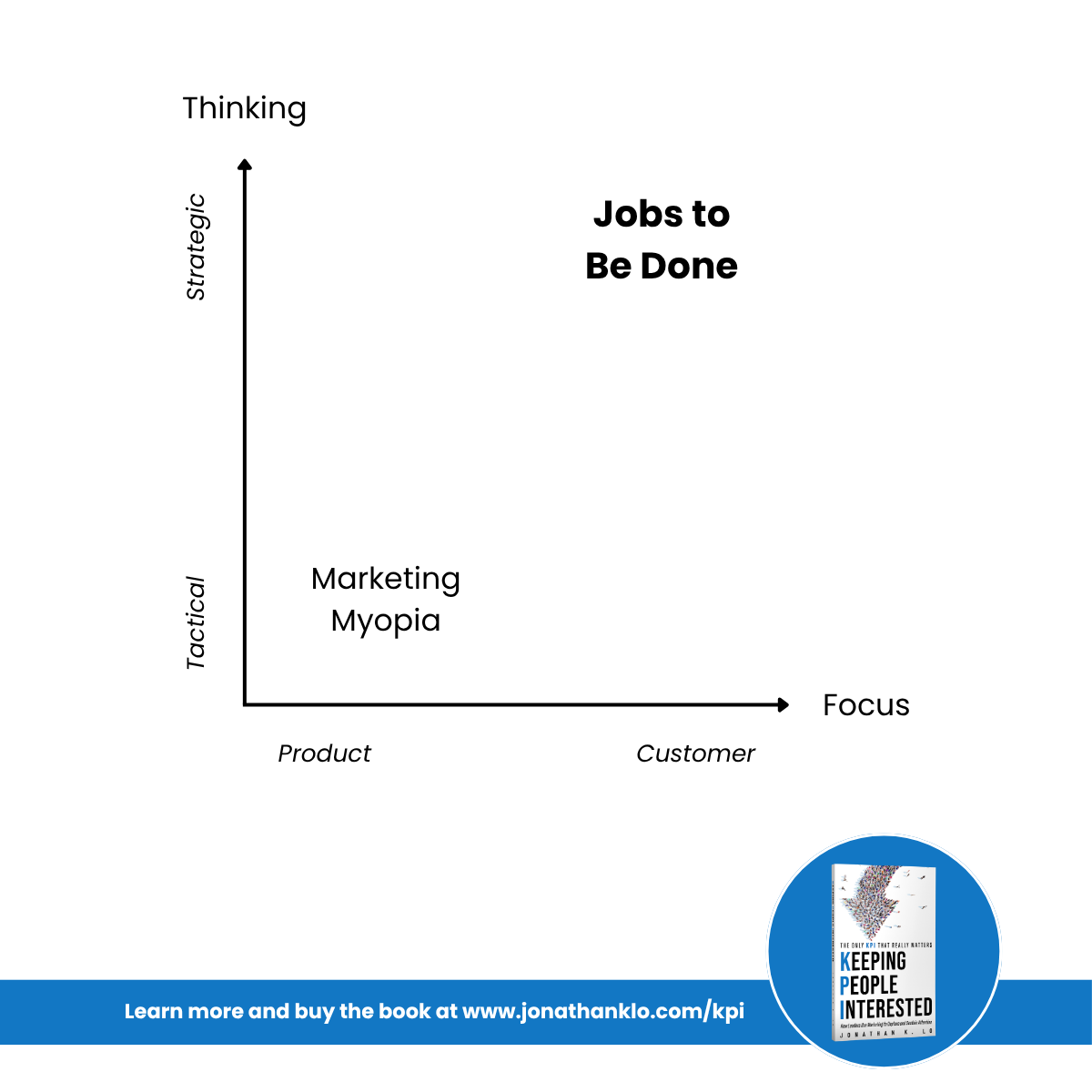
Where Jobs to Be Done demonstrates strategic thinking with a customer focus, Marketing Myopia is tactical and product-centric. The concept was introduced by Theodore Levitt in his 1960 Harvard Business Review article “Marketing Myopia.” Levitt argues that many companies fail because they define themselves too narrowly, focusing on their products rather than on the customer needs those products are meant to serve. He shares two classic examples:
The railroads did not stop growing because the need for passenger and freight transportation declined. That grew. The railroads are in trouble today not because that need was filled by others (cars, trucks, airplanes, and even telephones) but because it was not filled by the railroads themselves. They let others take customers away from them because they assumed themselves to be in the railroad business rather than in the transportation business. The reason they defined their industry incorrectly was that they were railroad oriented instead of transportation oriented; they were product oriented instead of customer oriented.
Hollywood barely escaped being totally ravished by television. Actually, all the established film companies went through drastic reorganizations. Some simply disappeared. All of them got into trouble not because of TV’s inroads but because of their own myopia. As with the railroads, Hollywood defined its business incorrectly. It thought it was in the movie business when it was actually in the entertainment business. “Movies” implied a specific, limited product. This produced a fatuous contentment that from the beginning led producers to view TV as a threat. Hollywood scorned and rejected TV when it should have welcomed it as an opportunity—an opportunity to expand the entertainment.
Levitt warns that if you define your business by the product you sell rather than the job your customer is trying to get done, you set yourself up for obsolescence. He captured this idea with a now-famous line: “People don’t want to buy a quarter-inch drill. They want a quarter-inch hole!”
While Marketing Myopia focuses inward on features, Jobs to Be Done focuses outward on outcomes. A company obsessed with product features might ask, “How do we sell brighter light bulbs?” A company using Jobs to Be Done asks, “How do we help people create a warm, well-lit environment?” That shift in perspective often reveals entirely new solutions or even new ways to position an existing one.
Marketing Myopia is not simply a lack of vision. It is a strategic blind spot that comes from confusing your product with your purpose. The antidote is continuous customer research and the discipline of asking not what you make, but what customers are truly trying to achieve.
Wrapping It All Up
The gap between Jobs to Be Done and Marketing Myopia comes down to a single question: are you describing what you make, or what your customer is trying to accomplish?
Ask yourself again: What does your company do? Try answering the question without naming your product. Focus only on the job someone might hire your product for.
Was this a simple exercise, or harder than you expected? Reach out and let me know how it went.
Interested in more?
This article’s content was adapted from the book Keeping People Interested: How Leaders Use Marketing to Capture and Sustain Attention, available as a paperback, ebook, and audiobook today.
Sources & Further Reading:
Clayton M. Christensen, Taddy Hall, Karen Dillon, and David S. Duncan, Competing against luck: The Story of Innovation and Customer Choice (HarperBusiness, 2016): xii.
Anthony W. Ulwick, Jobs to be done: Theory to Practice (Strategyn Holdings, LLC, 2016): 46, 54, 57.
T. Levitt, “Marketing myopia,” Harvard Business Review 38 (1960): 45–56.
Theodore Levitt, “Marketing Myopia,” Harvard Business Review (July–August 2004)
