
The 97% Rule: Why Most Buyers Aren't Ready Yet
What are you doing for the 97% who aren't buying today?
EXECUTIVE SUMMARY:The 97% rule says that roughly 97% of the people who visit your site are not ready to purchase. They are researching, comparing, and building confidence rather than rejecting you. This matters most in the Consideration stage of the Marketing Funnel, where customers start asking which solution is right for them. In this stage, you need to have empathy for the 97% of people who aren’t ready to purchase yet. Brands that win in this stage are the ones that demonstrate credibility and proof instead of applying pressure. Optimizing only for the 3% who are ready to buy today produces short-term conversions at the cost of long-term trust.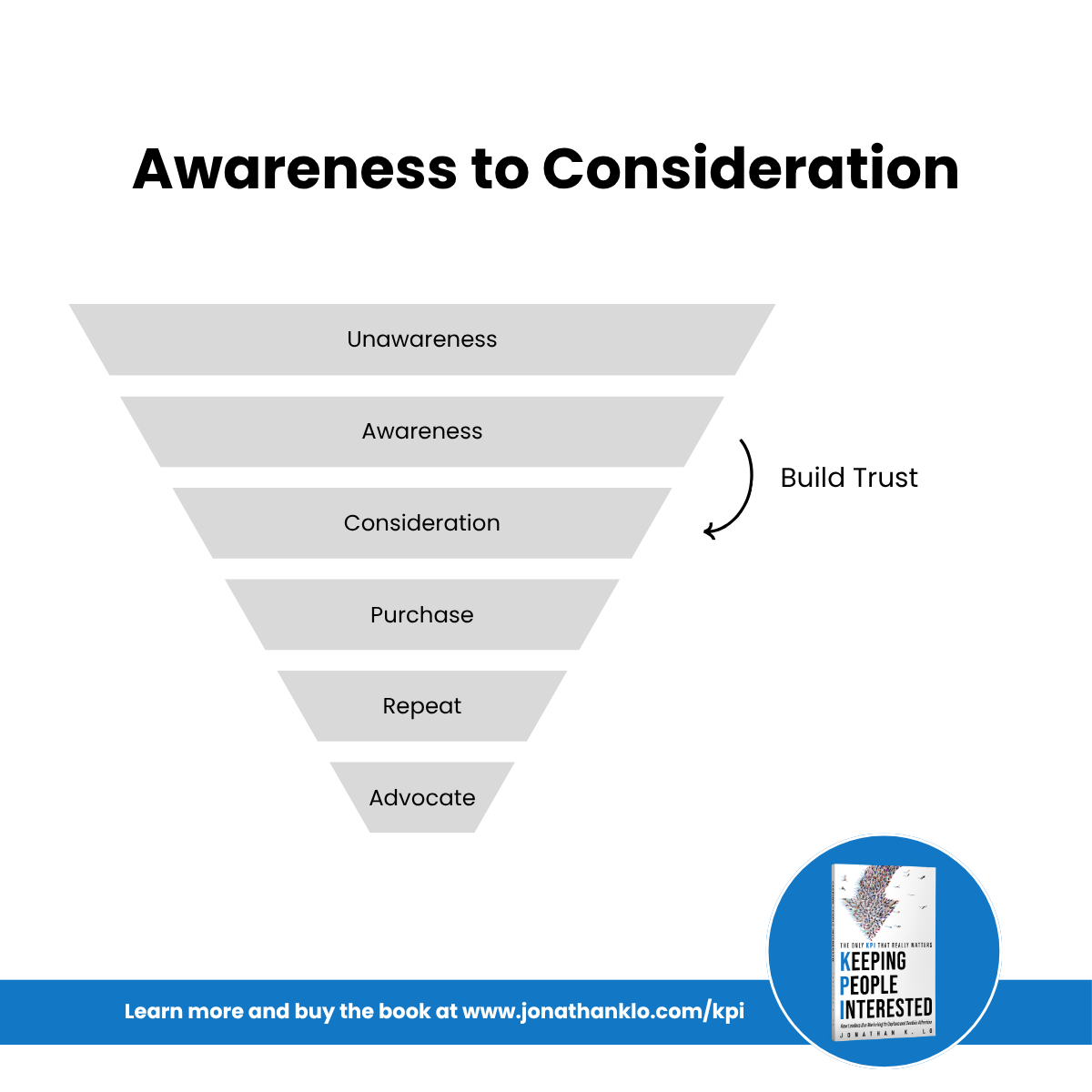
“People will forget what you said, people will forget what you did, but people will never forget how you made them feel.”
I once found myself at a military checkpoint in Egypt. My passport had been taken away, I was unable to speak the local language, and I overheard the captain say, “American,” several times into his phone. I was a person of interest, and I didn’t know why. Another time, I was bouncing through the streets of Delhi in an auto rickshaw at 1:00 a.m., tired, itchy from bedbug bites, carrying all my luggage, and lacking a hotel to go to. In other cases, I have slept in an old, converted communist camp in Russia and even wandered deep into sub-Saharan Kenya alongside local tribes.
On the surface, these situations may sound a bit precarious. And to be honest, I was a little nervous in Egypt and frustrated in India. Yet I rarely felt unsafe. Why? Because I trusted the people around me. They were locals I had spent time with before the situation unfolded. I’d met them through people I trusted. In word and deed, they had shown themselves to be reliable.
That trust changed everything. It turned moments that could have felt terrifying into ones I knew would simply make good stories—experiences that enriched my life. It made the difference between panic and perspective.
The idea of trust, or the lack of it, also applies to brands like yours. At times, customers will not approach you and immediately feel a sense of relief. Often, they are feeling uncertain, weighing risks, and wondering whether your solution is right for them. Just as I relied on people who proved trustworthy in unfamiliar places, customers rely on brands that demonstrate integrity, provide evidence, and show up consistently.
From Awareness to Consideration
In the Awareness stage of the marketing funnel, a customer recognizes that they have a problem and begins to look for solutions. They move from being Problem Unaware to Problem Aware to Solution Aware to Product Aware and finally, to Most Aware. By this point, they ideally understand their options and are ready to weigh them. This transition brings them into the Consideration stage of the funnel.
In the Consideration stage, customers evaluate different solutions and gather information to make an informed choice. They are no longer asking, “Do I have a problem?” Instead, they are asking, “Which solution is right for me?” The word consider itself means “to think of especially with regard to taking some action. At this stage, a purchase decision is being thought about carefully, with attention to details, trade-offs, and comparisons.
The bridge between Awareness and Consideration is the ability to build trust. To keep people interested, you need to address their core need to have confidence in your offering. This stage is driven less by emotion and more by rational evaluation. Customers are asking, “How does your product compare to competitors? How well does your service address the specific problem I want solved? How can you demonstrate reliability, credibility, and proof?” The more effectively you answer these questions, the more you build trust and the more likely customers are to see you as a serious option.
The 97% Rule
Let’s look closely at what happens in the Consideration stage and why it matters.
When customers reach this stage, you should expect them to visit your website without immediately making a purchase or signing up for a free consultation. That may sound obvious, but it can be easy and tempting to forget when you are watching your sales numbers closely.
For several years, I worked at a multibillion-dollar e-commerce retailer. The company tracked performance with remarkable precision. Executives received hourly updates showing whether sales were hitting projections. The difference between real sales and sales projections was measured in basis points, where a single basis point is 0.01%. At the time, the company sold about $2 billion worth of goods annually, which worked out to roughly $5.5 million per day, or $230,000 per hour. With numbers like that, a change of just one basis point in the conversion rate would impact $200,000 in annualized revenue. No wonder the organization was obsessed with the details.
This focus meant that when sales dipped, the immediate priority was optimizing for the roughly 3% of visitors who were ready to buy. While the company invested heavily in data science and analytics, and while longer-term testing was common, the short-term urgency always centered on that small slice of customers who were about to purchase.
From my perspective, that focus was too narrow. Yes, conversion rates matter. Yes, precision in measurement matters. But long-term growth depends on what I call the 97% rule: the recognition that most people who land on your site are not ready to purchase today. Roughly 97% of visitors are in research-and-evaluation mode. They are comparing, exploring, and building confidence. They are not rejecting you. They are simply not ready. Using pressure tactics to try to force them into buying now undermines trust and creates a cycle of diminishing returns.
I will add that leadership decisions at a publicly traded company are complex and filled with competing pressures I did not encounter firsthand. Yet in my role leading customer insights and strategy, I noticed a pattern. The company performed best in seasons when it prioritized customer research and focused on adding real value for the 97%. During times of stress, when short-term conversions were prioritized over long-term trust, results became more volatile, and the customer relationship suffered.
Wrapping It All Up
Here’s a simple takeaway: In the Consideration stage, expect customers to take their time. They are not ignoring you. They are gathering information, weighing their options, and looking for reasons to believe. Your job is to build trust by meeting them where they are, not by rushing them into action.
When you look at your own traffic, what have you built for the 97% who are not buying today? Or is nearly everything aimed at the small group that was already going to convert?
Interested in more?
This article’s content was adapted from the book Keeping People Interested: How Leaders Use Marketing to Capture and Sustain Attention, available as a paperback, ebook, and audiobook today.
Sources & Further Reading:
Merriam-Webster.com Dictionary, s.v. “consider,” accessed September 8, 2025
