
The Five Stages of Customer Awareness
Do your customers know they need what you're selling?
EXECUTIVE SUMMARY:There are Five Stages of Customer Awareness: the progression a potential customer makes from not recognizing a problem to becoming deeply familiar with a specific product. The five stages are Problem Unaware, Problem Aware, Solution Aware, Product Aware, and Most Aware. Understanding where a customer sits in this progression is essential, because effective marketing does not just promote a product. It helps people recognize their own challenges, discover that solutions exist, and identify a specific product as the right one for them.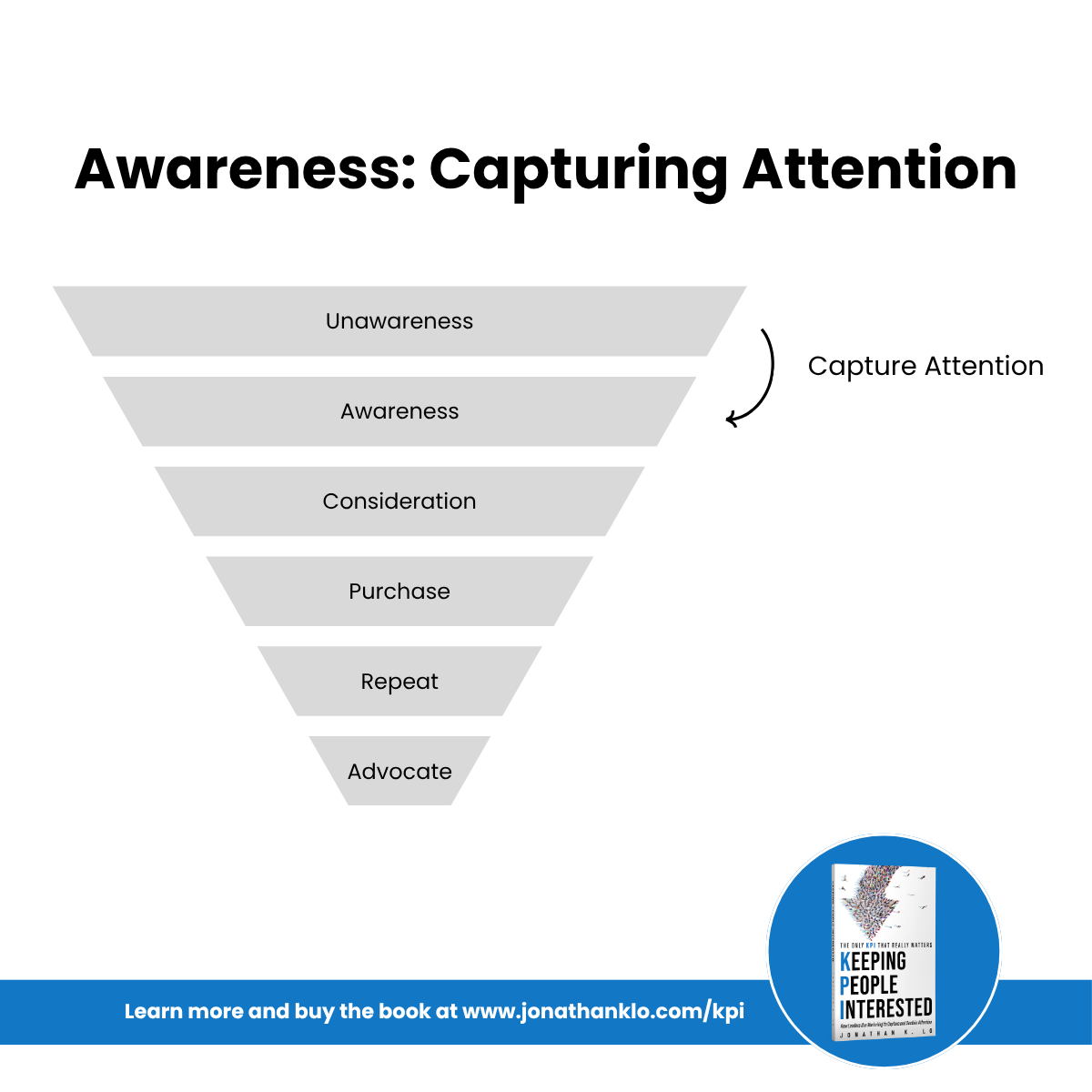
“Awareness is like the sun. When it shines on things, they are transformed.”
— Thich Nhat Hanh, Vietnamese monk and peace activist
If you couldn’t tell yet, I’m a bit of an optimist. I love nonprofits and support many on a recurring basis, but I also believe for-profit organizations can be an incredible force for good. A business adds value by its very existence because every transaction is a sign that someone found what it offered worthwhile. After all, why would anyone trade their money for goods or services if they didn’t see value in them?
Of course, as the saying from Spider-Man reminds us, “With great power comes great responsibility.” Too often, individuals and organizations with power fail to use it wisely. That is precisely why I am passionate about building and supporting all organizations that use their influence to actively benefit others.
Jensen Huang, founder and CEO of NVIDIA, once said, “There’s no point in starting a company unless you want to make a contribution to society.” The optimist in me agrees, but the pragmatist recognizes a challenge. Many founders create products that are genuinely useful and solve real problems, yet their companies still fail to gain traction.
A great product combined with great marketing can create an enormous contribution to society. But a great product with poor marketing often results in wasted potential and wasted resources.
People need to know your brand exists.
Let me share a simple statistic with you, one that requires no citation: Your company will sell zero products if zero people know you’re selling them.
You can’t buy something you don’t know exists. Imagine if you had never heard of Apple’s iPhone, Toyota’s Prius, or even nonstick pans. All the research and development in the world wouldn’t matter if those products sat in warehouses, unseen and unsold simply because nobody knew they were available.
Did you know that 50% of consumers are more likely to buy from brands they recognize? Honestly, I’m surprised the number isn’t higher. The real question is this: Would you rather be the brand people already know and trust or start from scratch every time, working to convince them your product or service is the right fit?
The Awareness stage of the funnel is all about being aware, which Merriam-Webster defines as “having or showing realization, perception, or knowledge.” In marketing terms, awareness means someone knows your brand exists. But how do they get there?
We All Start Unaware
Before we dive into strategies for brand awareness, we need to take a step back because Awareness is not the starting point. The journey begins in a stage called Unawareness. At this point, a potential customer does not know your brand, does not recognize your product, and may not even realize they have a problem that needs solving.
This stage is critical because until someone becomes aware of their own needs, they will not be open to hearing about solutions. Great marketing does more than promote a brand. It helps people recognize challenges or opportunities in their own lives, then positions your product or service as the natural answer once people are ready to move forward.
The Five Stages of Awareness
Unawareness is just the beginning. Customers move through a series of stages as they progress from not recognizing a problem to becoming deeply familiar with a specific product. These stages of Awareness are:
Problem Unaware
Problem Aware
Solution Aware
Product Aware
Most Aware
Defining the Problem
When we talk about a problem, we are not simply describing something negative. A problem is any job that needs to be done. This perspective draws from the Jobs to Be Done theory, which suggests that consumers are constantly “hiring” or “firing” products based on whether they fulfill the job they require.
For example, you might ask a customer, “Do you need a kitchen knife? Or do you need a tool that helps you prepare a beautiful meal for a dinner party?” “Do you need a blender? Or do you need a way to enjoy a healthy smoothie every morning?”
The problem is the job.
You can’t keep people interested if there is no basis for the interest to exist in the first place.
From Problem to Product
Once a problem is recognized, the next stage is becoming aware that solutions exist. A solution refers to a category of products or services designed to address that problem. In the smoothie example, the solution could be any kitchen tool that blends, purees, or mixes.
From there, awareness shifts to specific offerings in that category. In this context, a product is a particular unit, brand, or service that fulfills the requirements of the solution. This is where your company enters the picture. A customer in the Product Aware stage has heard of your product, but that does not necessarily mean they know much about it.
The Most Aware Stage
At the final stage, Most Aware, customers have a deep familiarity with your product. They know its features, benefits, and value, and they understand how it can solve their problem.
Imagine walking through a food hall: You may know that one restaurant serves a turkey sandwich and another offers teriyaki chicken. In that moment, you are fully aware of what each option provides. That level of familiarity is what it means to be Most Aware.
At this stage, a brand has successfully communicated what it offers and how it fits into a customer’s world. Awareness alone does not guarantee action, but it represents the highest level of recognition a customer can reach before moving on to the next stage of the journey.
A Personal Story in Awareness: Huel
To make this more concrete, let me share a personal story about how I moved through the stages of Awareness with a problem I never expected to care about: dog food for humans.
A couple years ago, I was house-sitting for some friends and watching their sweet pit bull mix, Coco. I had never owned a dog before, so caring for her was a new experience. Every day, we went for walks, sat in the sun, and settled by the fireplace. She was happy, healthy, and full of energy. And, like clockwork, she ate the same food every day—a nutritionally complete mix designed to give her everything she needed for a long and healthy life.
Watching her thrive on that consistent, efficient diet made me pause. At the time, I was juggling graduate school and long work hours, often skipping meals or grabbing whatever was quick. Cooking healthy meals felt time-consuming, and eating out was expensive and set my health goals back. Coco had it figured out. I wanted what she had. I wanted dog food for humans.
Curious, I turned to the internet. This was before the age of artificially intelligent assistants, so I began searching for phrases like “full nutrition food” and “complete meal replacement.” That is when I discovered two brands: Soylent and Huel.
Soylent positioned itself as sleek and minimalist, a ready-to-drink fuel for busy people. Huel leaned into its nutritional completeness and variety, offering powders and shakes designed to meet 100% of daily nutrient needs with a stronger emphasis on whole-food ingredients.
What tipped the scales for me was a video of someone attempting a thirty-day Huel challenge, living exclusively on Huel for an entire month. Watching their energy levels and health markers change convinced me that this was not just a theoretical product. It worked for someone in real life. If a man could live on it for thirty days, using it a few times a week to cover nutritional gaps seemed like a great option. That one authentic story pushed me from awareness into action.
Looking back, my journey illustrates the five stages of Awareness:
Problem Unaware: I did not realize poor nutrition was holding me back. Skipping meals felt normal.
Problem Aware: Coco’s consistent, healthy routine made me recognize my own diet was inconsistent and lacking.
Solution Aware: I discovered the concept of complete meal replacements as a category that could solve my problem.
Product Aware: My research led me to two specific brands, Soylent and Huel, and I began comparing them.
Most Aware: I became deeply familiar with Huel’s features and benefits, especially after watching the thirty-day challenge. This made me feel confident that it could be a real solution for me.
This story shows how people move step-by-step, from not realizing they even have a problem to becoming convinced that a specific product can meet their needs. Marketing’s role is to guide that journey thoughtfully, helping people see their challenges more clearly, discover solutions, and finally recognize your product as the one that fits.
Wrapping It All Up
The Five Stages of Customer Awareness offer a useful lens for understanding where your customers are within the “Awareness” phase of the marketing funnel. Most people do not start as buyers. They start as people who do not yet realize they have a problem you can solve. Your marketing's job is to walk alongside them at every stage, building enough recognition and trust that when they are ready to act, your product is the one they reach for.
Is your marketing reaching people at the right awareness stage? Or are you spending most of your effort talking to people who are already Product Aware, when your biggest growth opportunity might be higher up in the funnel?
Interested in more?
This article’s content was adapted from the book Keeping People Interested: How Leaders Use Marketing to Capture and Sustain Attention, available as a paperback, ebook, and audiobook today.
